Recommender Systems — A Complete Visual Guide
The complete visual guide to recommendation engines — from user-item matrices to matrix factorization, content-based vs collaborative filtering, hybrid approaches, and production patterns at Netflix and Spotify scale. Interactive rating matrices, latent factor visualizations, and live recommendation demos.
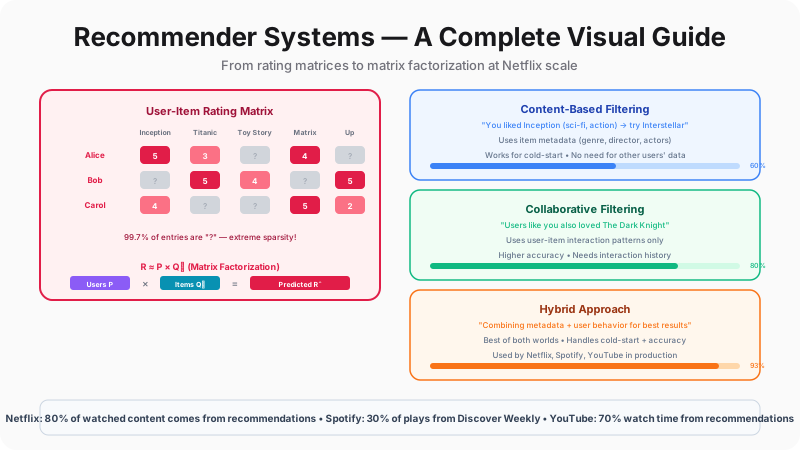
Why Recommender Systems Exist — The Paradox of Choice
Open Netflix. You see a homepage with maybe 40 titles — neatly organized into rows like “Because you watched Inception” and “Trending Now.” Feels simple, right? Behind that clean interface, Netflix has 17,000+ titles in its catalog and 260 million subscribers, each with different tastes. The homepage you see is not the same one your neighbor sees. Every single row, every movie poster, even the artwork shown for each title is personalized. And 80% of what people watch on Netflix comes from these recommendations — not from browsing or searching.
This isn't unique to Netflix. Spotify has 100 million tracks — a person listening 8 hours a day would need 1,500 years to hear them all. YouTube users upload 500 hours of video every minute. Amazon sells 350 million products. Without recommendation systems, these platforms would be unusable. The user would drown in choices, engagement would plummet, and the business would die. Recommender systems are not a nice-to-have — they are the product.
At the mathematical core, every recommender system is solving the same problem: given a giant user-item rating matrixwhere 99%+ of entries are unknown, predict the missing values. Which movies would Alice rate 5 stars? Which songs would Bob play on repeat? Which products would Carol add to her cart? The approaches differ — some use item features, some use user behavior patterns, some use both — but the data structure is always the same sparse matrix. Let's build one.
The Scale Problem — Why Recommendations Matter
When you have millions of items and millions of users, browsing is impossible. Recommendations are the product.
Catalog
17,000+ titles
Users
260M subscribers
Impact
80% of watched content from recommendations
Two Kinds of User Signal
How do we know what a user likes? Two fundamentally different approaches.
Ratings the user deliberately provides — star ratings, thumbs up/down, reviews. Tells you exactly how much a user liked something.
Advantages
✓ High signal — directly measures preference
✓ Easy to interpret (5 stars = loved it)
Challenges
✗ Very sparse — most users don't rate most items
✗ Biased — people rate things they feel strongly about
Typical sparsity: < 1% of user-item pairs have ratings
The User-Item Rating Matrix — The Core Data Structure
Every recommender system starts here. Rows are users, columns are items. Most cells are empty — filling them is the entire challenge.
Inception Sci-Fi | The Notebook Romance | Toy Story Animation | The Dark Knight Action | Frozen Animation | Titanic Romance | Interstellar Sci-Fi | The Avengers Action | |
|---|---|---|---|---|---|---|---|---|
| Alice | ★★★★★ | ★★ | ? | ★★★★★ | ? | ★ | ★★★★ | ★★★★★ |
| Bob | ? | ★★★★★ | ★★★★ | ? | ★★★★★ | ★★★★ | ? | ? |
| Carol | ★★★★ | ? | ? | ★★★★★ | ? | ? | ★★★★★ | ★★★★ |
| Dave | ? | ★★★★ | ★★★★★ | ? | ★★★★ | ★★★★★ | ? | ? |
| Eve | ★★★ | ? | ? | ★★★★ | ? | ? | ? | ★★★ |
40
Total cells (users × movies)
21
Known ratings
47.5%
Unknown (sparsity)
The core problem: We have a huge matrix where 47.5% of entries are missing. The job of every recommender system is to predict these missing values — and recommend items with the highest predicted ratings. At Netflix scale (260M users × 17K titles), this matrix has 4.4 trillion cells, and over 99.7% are empty.
We now have a sparse rating matrix and understand the two types of user signal. The simplest approach to filling in missing ratings is content-based filtering— using what we know about the items themselves. If you liked Inception (sci-fi, action, Nolan), we recommend Interstellar (sci-fi, action, Nolan). No need to look at other users. Let's see how this works with our movie dataset.
Content-Based Filtering — “More Like This”
Content-based filtering is the most intuitive approach: if you liked something, you'll probably like similar things. A movie is described by its features — genre tags, director, cast, release year, runtime. Each movie becomes a feature vector— a list of numbers encoding its properties. A user profile is built by averaging the feature vectors of movies they've rated highly. Recommendation is then simple: find movies whose feature vectors are closest to the user's profile.
The distance metric that works best for feature vectors is cosine similarity. Instead of measuring how far apart two vectors are (Euclidean distance), cosine similarity measures the anglebetween them. Two movies with cosine similarity of 0.95 are nearly identical in genre profile, regardless of how “intense” their individual scores are. A mildly sci-fi movie and a deeply sci-fi movie can still be similar if their genre proportions match.
The beauty of content-based methods is cold-start handling. A brand-new movie with zero ratings can still be recommended, because we know its genre, director, and cast. The weakness? Filter bubbles. If you've only rated action movies, you'll only get recommended action movies. You'll never discover that you might love Studio Ghibli animations. This is where collaborative filtering breaks the bubble.
Step 1 — Represent Each Movie as a Feature Vector
Every movie is described by how much it belongs to each genre — a numerical fingerprint that captures its identity.
Inception (2010)
Inception = [0.9, 0.1, 0.0, 0.7, 0.5]Step 2 — Find Similar Movies via Cosine Similarity
Cosine similarity measures the angle between two feature vectors. Closer to 1.0 = more similar genre profile.
Recommended (most → least similar):
Interstellar (2014)
96%
similarity
The Avengers (2012)
87%
similarity
The Dark Knight (2008)
84%
similarity
Titanic (1997)
41%
similarity
The Notebook (2004)
33%
similarity
Toy Story (1995)
31%
similarity
Frozen (2013)
23%
similarity
Cosine Similarity formula:
cos(A, B) = (A · B) / (‖A‖ × ‖B‖) = Σ(aᵢ × bᵢ) / (√Σaᵢ² × √Σbᵢ²)
Content-based advantage: This works even for brand-new movies with zero ratings — as long as we know the genre tags. That's called cold-start handling. The downside? It only recommends movies similar to what you've already watched. You'll never discover that you might love documentaries if you've only rated action films.
Build Your User Profile
Rate some movies and watch your preference profile emerge — a weighted combination of movie features.
Your Preference Profile
Content-based filtering works, but it has a ceiling: it can only recommend things similar to what you've already seen. The more powerful approach is collaborative filtering— looking at patterns across allusers to discover hidden taste relationships. Alice and Carol have similar taste, so what Carol loved but Alice hasn't seen becomes a strong recommendation. No genre labels needed — just the raw rating matrix. Let's see how matrix factorization makes this work.
Collaborative Filtering — “Users Like You Also Loved”
Collaborative filtering is the algorithm that won the Netflix Prize— a $1 million competition where teams competed to improve Netflix's recommendation accuracy by 10%. The winning insight was matrix factorization: decompose the giant, sparse rating matrix into two smaller, dense matrices that, when multiplied together, reconstruct the original ratings — including the missing ones.
Think of it this way. Every user has a hidden “taste vector” — maybe 20 numbers that encode how much they like action, romance, cerebral plots, visual effects, etc. Every movie has a corresponding “characteristic vector” — 20 numbers encoding how much it contains those same qualities. A user's predicted rating for a movie is simply the dot productof their taste vector and the movie's characteristic vector. These hidden vectors are called latent factors, and the algorithm learns them automatically from the rating data — no genre labels needed.
The visualization below maps our users and movies into a 2D latent space. Notice how Alice and Carol cluster together (both are sci-fi/action fans), while Bob and Dave cluster together (romance/animation fans). The movies cluster similarly. When a user is close to a movie in this space, the dot product is large — meaning a high predicted rating. This is the geometric intuition behind matrix factorization. Hover over a user to see the predicted ratings and connection strengths.
The Latent Space — Where Users and Movies Live Together
Matrix factorization maps users and movies into the same 2D space. Nearby points = high predicted rating.
The Math — Matrix Factorization Step by Step
Don't worry — we'll walk through each piece of the formula.
The Goal: R ≈ P × Qᵀ
r̂ᵤᵢ = pᵤ · qᵢ = Σₖ pᵤₖ × qᵢₖDecompose the sparse rating matrix R (users × items) into two smaller dense matrices: P (users × f latent factors) and Q (items × f latent factors). The predicted rating is the dot product of the user and item vectors.
Predicted Ratings — Filling in the Blanks
The factorized model can now predict every missing cell in the matrix. Green = known rating, amber = predicted.
| Inception | The Notebook | Toy Story | Dark Knight | Frozen | Titanic | Interstellar | Avengers | |
|---|---|---|---|---|---|---|---|---|
| Alice | 5 | 2 | 1.4 | 5 | 1.1 | 1 | 4 | 5 |
| Bob | 1.0 | 5 | 4 | 1.0 | 5 | 4 | 1.1 | 1.0 |
| Carol | 4 | 1.4 | 1.5 | 5 | 1.2 | 1.1 | 5 | 4 |
| Dave | 1.1 | 4 | 5 | 1.0 | 4 | 5 | 1.2 | 1.1 |
| Eve | 3 | 1.4 | 1.5 | 4 | 1.4 | 1.3 | 3.1 | 3 |
Notice the patterns: Alice and Carol (action/sci-fi lovers) get high predictions for each other's favorites. Bob and Dave (romance/animation fans) similarly cluster together. The model discovered these taste groups automatically from the rating patterns — no genre labels needed!
Collaborative filtering is powerful — it discovers taste patterns that content features can't capture. But it completely fails when there's no interaction data: new users with no ratings, new movies with no views. The solution? Hybrid approaches that combine the cold-start resilience of content-based methods with the pattern-discovery power of collaborative filtering. This is what every major platform actually uses in production.
Hybrid Approaches — Best of Both Worlds
In practice, no production recommendation system uses just content-based or justcollaborative filtering. The state of the art is hybrid models that combine item metadata (genre, director, cast) with user interaction patterns (ratings, watches, clicks) in a single unified model. The most popular algorithm in this class is LightFM, which elegantly extends matrix factorization to incorporate metadata.
The key insight of LightFM is beautifully simple: instead of learning one monolithic embedding per user, learn an embedding per user tag(male, age:25-34, location:US). The user's overall embedding is the sumof their tag embeddings. Similarly, each movie's embedding is the sum of its tag embeddings (genre:sci-fi, director:Nolan, year:2014). A brand-new movie tagged as “sci-fi” immediately gets a meaningful embedding from the learned sci-fi vector — no ratings needed.
This is why hybrid approaches dominate in production. Netflix, Spotify, and YouTube all use some variant of this pattern: metadata features for cold-start, interaction patterns for accuracy, and learned embeddings that bridge both. The cold-start problem— the most important practical challenge in recommendations — is solved elegantly by hybrid models. Let's compare all three approaches side by side and see how LightFM works under the hood.
Three Approaches — Side by Side
Each approach answers the same question differently: “What should this user watch next?”
Combine metadata AND interaction patterns. User/item embeddings are built from both tag features and learned latent factors.
pᵤ = Σ xᵃᵤ   (sum of user tag embeddings)
qᵢ = Σ xᵃᵢ   (sum of item tag embeddings)
r̂ᵤᵢ = pᵤ · qᵢ + bᵤ + bᵢ
"Based on your sci-fi preference AND users like you → try Arrival"
Strengths
✓ Handles cold-start via metadata
✓ Leverages interaction patterns for accuracy
✓ Best of both worlds
Weaknesses
✗ More complex to implement
✗ Needs both metadata AND interactions
✗ Slower training
Used by: Spotify Discover Weekly, YouTube, Netflix (production systems)
How LightFM Works — Hybrid Matrix Factorization
The key insight: user and item embeddings are sums of tag embeddings. New items with known tags get instant embeddings.
User Embedding: pᵤ = Σ xᵃᵤ
Alice's tags:
p_alice = sum of all above vectors
Item Embedding: qᵢ = Σ xᵃᵢ
Interstellar's tags:
q_interstellar = sum of all above vectors
Three modes of LightFM:
Cold-start mode
New item with tags but no ratings → use tag embeddings only (no indicator)
Pure collaborative
Only indicator features → reduces to standard matrix factorization (SVD)
Full hybrid
Tags + indicators → best of both worlds. This is the production setup.
The Cold-Start Problem — How Each Approach Handles It
The most important practical difference between approaches. What happens when we have no data?
Scenario: A new movie is added to the catalog. No users have rated it yet. How do we recommend it to anyone?
🏷️ Content-Based
Use movie metadata (genre: sci-fi, director: Villeneuve, actors: Chalamet). Find similar known movies.
👥 Collaborative
Cannot help — no user-item interactions exist for this movie. It sits invisible in the catalog.
🔀 Hybrid
Map item tags to learned embeddings. The movie gets a meaningful representation from day one.
Winner: Hybrid / Content-Based
We now understand the three approaches and their tradeoffs. But how do we measure whether our recommendations are actually good? And what does a production recommendation system look like at Netflix, Spotify, and YouTube scale? The final section covers evaluation metrics, A/B testing, and the architectural patterns that power billions of recommendations per day.
Evaluation, A/B Testing, and Production Patterns
A recommendation model that looks great on a held-out test set might fail spectacularly in production. The Netflix Prize is the most famous example: the winning team improved RMSE by 10.06% — a significant mathematical achievement — but Netflix never fully deployed the winning algorithm because the marginal business impact didn't justify the engineering complexity. Offline accuracy and online business metrics are related but not identical. You need both.
The right evaluation metric depends on what you're measuring. RMSE measures rating prediction accuracy — useful for explicit feedback. Precision@K and Recall@K measure recommendation relevance — useful for implicit feedback. NDCG@K measures ranking quality — whether the best items appear at the top. In production, the ultimate metric is always a business KPI measured through A/B testing: watch time, click-through rate, subscription retention, or revenue.
Let's explore each metric, understand the difference between offline evaluation and online experiments, and then look at how Netflix, Spotify, and YouTube actually architect their recommendation systems at scale.
Evaluation Metrics — How Do You Know It Works?
Different metrics measure different things. The right metric depends on your feedback type and business goal.
RMSE = √(Σ(rᵤᵢ - r̂ᵤᵢ)² / N)
Measures average prediction error in the same units as ratings. An RMSE of 0.85 means predictions are off by ~0.85 stars on average. Lower is better.
When to use
Explicit feedback (star ratings). The Netflix Prize optimized for this metric.
Range
0 (perfect) to ~2.0 (terrible for 1-5 scale)
Example
Predicted 4.2 stars, actual 5 stars → error = 0.8, squared = 0.64
Offline Metrics vs Online Experiments
A model that looks great on a test set might fail in production. Here's why you need both.
How it works: Split historical interaction data into train/test sets. Train the model on past data, evaluate predictions on held-out data.
1. Split data by time
Training: Jan-Oct ratings. Test: Nov-Dec ratings. Never random split — that causes data leakage.
2. Train model on training set
Fit matrix factorization or hybrid model on historical ratings.
3. Predict on test set
For each (user, item) pair in test, predict the rating.
4. Compute metrics
RMSE for explicit, Precision/Recall/NDCG@K for implicit feedback.
Limitation: Offline metrics only measure accuracy on observed interactions. They can't measure discovery — did the user enjoy a movie they wouldn't have found on their own? This is why Netflix improved RMSE by 10% in the Netflix Prize but saw minimal business impact.
Production Patterns — Netflix, Spotify, YouTube
How the biggest platforms in the world actually build their recommendation engines.
Netflix Recommendation System
Architecture
Two-stage: candidate generation (fast, retrieves ~1000 candidates from 17K titles) → ranking model (accurate, scores and orders the candidates). Uses a mix of collaborative filtering, content features, and contextual signals (time of day, device, recent watches).
Scale
260M users × 17K titles. Recommendations drive 80% of content watched.
Key Insight
The "artwork personalization" system chooses different poster images for the same movie based on user taste. A romance fan sees the love scene; an action fan sees the explosion.
Tech Stack
Custom ML platform on AWS. Real-time inference with cached embeddings. Offline model training on Spark.
Build It Yourself — Python Implementation
Complete runnable code for both collaborative filtering and hybrid approaches.
from surprise import Dataset, Reader, SVD
from surprise.model_selection import cross_validate
import pandas as pd

# Our movie ratings dataset
ratings_data = {
    'user': ['Alice','Alice','Alice','Alice','Bob','Bob','Bob',
             'Carol','Carol','Carol','Dave','Dave','Dave','Eve','Eve'],
    'item': ['Inception','Notebook','Dark Knight','Interstellar',
             'Notebook','Toy Story','Titanic',
             'Inception','Dark Knight','Interstellar',
             'Notebook','Toy Story','Titanic',
             'Inception','Dark Knight'],
    'rating': [5, 2, 5, 4,  5, 4, 4,  4, 5, 5,  4, 5, 5,  3, 4]
}

df = pd.DataFrame(ratings_data)
reader = Reader(rating_scale=(1, 5))
data = Dataset.load_from_df(df[['user', 'item', 'rating']], reader)

# Train SVD with 20 latent factors
algo = SVD(n_factors=20, n_epochs=30, lr_all=0.005, reg_all=0.02)
results = cross_validate(algo, data, measures=['RMSE'], cv=3)
print(f"Mean RMSE: {results['test_rmse'].mean():.4f}")

# Predict: What would Alice rate Toy Story?
algo.fit(data.build_full_trainset())
pred = algo.predict('Alice', 'Toy Story')
print(f"Alice → Toy Story: {pred.est:.2f} stars")
Surprise (SVD)
Best for: explicit feedback (star ratings). Clean API. Great for learning and prototyping.
LightFM (Hybrid)
Best for: implicit feedback + cold start. Uses item/user metadata. Production-ready with WARP loss.
The Complete Picture
Let's connect everything. At the data level, recommender systems work with a sparse user-item matrix populated by explicit ratings or implicit interaction signals. At the algorithmic level, content-based filtering uses item features and cosine similarity, collaborative filtering uses matrix factorization to discover latent taste factors, and hybrid approaches combine both through tag-level embeddings. At the evaluation level, offline metrics (RMSE, Precision@K, NDCG@K) provide fast iteration, while online A/B tests measure actual business impact.
The evolution mirrors the industry's journey: Netflix started with simple collaborative filtering, added content features, and now runs deep learning models that fuse dozens of signal types. Spotify uses audio fingerprinting to solve cold-start for new songs. YouTube optimizes for watch time, not clicks, to avoid the clickbait trap. Each system is a custom blend of the principles we've explored here — content features, interaction patterns, learned embeddings, and rigorous evaluation. You now know the vocabulary, the math, and the architecture behind every recommendation you see on the internet.