K-Means Clustering — A Complete Visual Guide
The complete visual guide to K-Means clustering — from random initialization to convergence, interactive step-by-step iterations, the elbow method, silhouette scores, and real-world pitfalls. Watch centroids move in real time and build intuition for when K-Means works and when it breaks.
What Is K-Means Clustering — And Why Is It Everywhere?
Imagine you run an online store with 100,000 customers. You want to segment them into groups for targeted marketing, but you don't have pre-defined categories. Some customers buy cheap items frequently. Others make rare but expensive purchases. Some fall somewhere in between. You can feelthat groups exist, but you can't draw the boundaries manually for 100,000 people. You need an algorithm that discovers these groups automatically, purely from the data — no labels, no predefined categories.
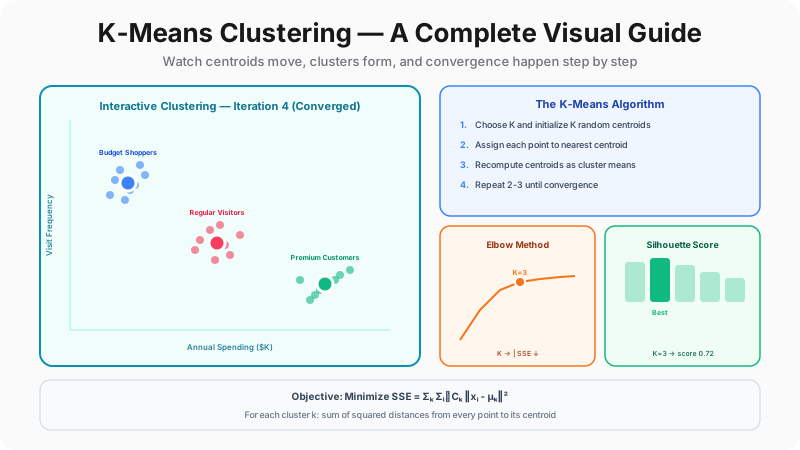
This is clustering, and K-Meansis the most widely used clustering algorithm in the world. It takes unlabeled data (just numbers — no “this customer is premium” labels) and groups it into K clusters, where K is a number you choose. The algorithm works by placing K “centroids” (cluster centers) in the data, then iteratively refining their positions until each centroid sits at the center of its natural cluster. It's beautifully simple: assign each point to the nearest centroid, move each centroid to the average of its assigned points, repeat. In 5-15 iterations, you have your clusters.
K-Means is used everywhere: customer segmentation at Amazon, image compression in graphics pipelines, document clustering in search engines, color palette extraction in design tools, anomaly detection in cybersecurity, and gene expression grouping in bioinformatics. It's the first algorithm data scientists reach for when they need to find structure in unlabeled data. Let's understand it from the ground up, using a customer shopping dataset.
Supervised vs Unsupervised — Where Clustering Lives
Most ML you've seen is supervised (labeled data). Clustering is unsupervised — we discover structure without labels.
No labels at all. You have raw data and want to discover hidden structure. “Are there natural groups in my customer data?” The algorithm finds patterns you didn't know existed.
Examples: K-Means, DBSCAN, PCA, Hierarchical Clustering
Our Dataset: Customer Shopping Behavior
18 customers, 2 features: annual spending ($K) and monthly store visits. Can K-Means discover the natural customer segments?
| ID | Spending ($K) | Visits/Month |
|---|---|---|
| 1 | 12 | 28 |
| 2 | 8 | 32 |
| 3 | 15 | 25 |
| 4 | 10 | 30 |
| 5 | 6 | 35 |
| 6 | 14 | 22 |
| ... 12 more rows | ||
The question: Looking at the scatter plot, you can probably see three groups — but the algorithm doesn't know that. It has no labels, no hints. K-Means will discover these groups purely from the geometric structure of the data. Let's watch it happen.
The K-Means Algorithm — Five Steps
The entire algorithm fits in a tweet. The elegance is in the convergence — simple steps, powerful results.
Decide how many clusters you want (K=3 for our data). This is the main hyperparameter.
K-Means Pseudocode:
Input: X (N data points), K (number of clusters)

1. centroids = random_sample(X, K)     # pick K random points
2. repeat:
3.   for each point xᵢ:
4.     cluster[i] = argmin_k ‖xᵢ - centroid_k‖²   # nearest centroid
5.   for each cluster k:
6.     centroid_k = mean(points in cluster k)        # new center
7.   if centroids barely changed: break              # converged!

Output: K cluster assignments + K centroid positions
The math objective: K-Means minimizes SSE (Sum of Squared Errors) = Σₖ Σᵢ∈Cₖ ‖xᵢ - μₖ‖². In words: for each cluster, sum the squared distances from every point to its centroid. The algorithm provably decreases this value at every iteration until convergence.
We now understand the problem (unsupervised grouping), the data (18 customers with spending and visit features), and the five-step algorithm. But reading pseudocode is one thing —watchingK-Means run is another. In the next section, you'll see centroids move in real time, watch points change colors as they get reassigned, and see SSE drop at every iteration. This is where the intuition clicks.
Step-by-Step — Watch K-Means Converge
The interactive visualization below is the heart of this tutorial. You'll see the full K-Means algorithm execute on our customer dataset — starting from random centroid positions, assigning points, moving centroids, and converging to stable clusters. Each iteration, the SSE (total error) drops. The algorithm is guaranteed to convergebecause every step either decreases SSE or leaves it unchanged.
Pay attention to two things as you watch. First, the assignment step: each point gets colored by its nearest centroid. Some points near cluster boundaries might switch colors between iterations. Second, the update step: centroids move to the center of mass of their assigned points. Initially they jump around; as the algorithm converges, the movements become tiny until the centroids settle.
After the main visualization, we'll break down the two core operations: distance calculation (how does a point “know” which centroid is closest?) and centroid updating (why does the mean minimize SSE?). These are the two building blocks — if you understand them, you understand K-Means completely.
Watch K-Means Run — Live Iteration Viewer
Press play to watch centroids move, points get reassigned, and SSE drop — iteration by iteration.
Points: 6 | SSE: 183.0
Centroid: (12.0, 28.0)
Points: 5 | SSE: 468.0
Centroid: (70.0, 4.0)
Points: 7 | SSE: 546.0
Centroid: (35.0, 18.0)
SSE across iterations
SSE decreases at every iteration — guaranteed by the algorithm!
How Assignment Works — Euclidean Distance
For each point, compute the distance to every centroid. Assign it to the nearest one. That's it.
Euclidean Distance formula:
d(p, c) = √((p.x - c.x)² + (p.y - c.y)²)
√((12 - 11)² + (28 - 29)²)
√((12 - 60)² + (28 - 4)²)
√((12 - 33)² + (28 - 16)²)
How Centroids Move — Computing the Mean
After assigning points, each centroid moves to the average position of its cluster members.
Cluster A — 6 points assigned
| Point | Spending (x) | Visits (y) |
|---|---|---|
| Customer 1 | 12 | 28 |
| Customer 2 | 8 | 32 |
| Customer 3 | 15 | 25 |
| Customer 4 | 10 | 30 |
| Customer 5 | 6 | 35 |
| Customer 6 | 14 | 22 |
| New Centroid | 10.8 | 28.7 |
new_centroid.x = (12 + 8 + 15 + 10 + 6 + 14) / 6 = 10.8new_centroid.y = (28 + 32 + 25 + 30 + 35 + 22) / 6 = 28.7Why the mean? Using calculus, you can prove that the point minimizing the sum of squared distances to a set of points is exactly their mean. This is why K-Means uses the average — it's the optimal centroid position for minimizing SSE within each cluster.
The algorithm converged beautifully on our dataset — three clean clusters emerged from random initialization. But we chose K=3 because we could seethree groups. In real datasets with 50 features, you can't visualize the data. How do you choose K objectively? Two complementary methods: the elbow method (minimizing SSE) and the silhouette score(maximizing cluster separation). Let's explore both.
Choosing K — The Hardest Decision in Clustering
K-Means has essentially one hyperparameter: K, the number of clusters. Unlike supervised learning where you have a test set to measure accuracy, unsupervised learning has no “correct answer” to check against. Choosing K is part science, part art. Too few clusters and you miss important subgroups. Too many and you overfit to noise, creating meaningless micro-clusters.
The elbow methodplots SSE against K. SSE always decreases as K increases (at K=N, every point is its own cluster with SSE=0), so we look for the “elbow” — the point where the drop becomes marginal. Going from K=2 to K=3 might cut SSE in half; going from K=3 to K=4 might only cut it by 5%. That's your signal.
The silhouette score adds a second perspective. Instead of measuring compactness (SSE), it measures separation— how much overlap exists between clusters. A silhouette score near 1.0 means clusters are dense and far apart. Near 0 means they overlap significantly. When both the elbow method and silhouette score point to the same K, you have high confidence. Let's see both in action.
The Elbow Method — Finding the Right K
Plot SSE vs K. Where the curve bends sharply (the “elbow”) is the sweet spot — adding more clusters gives diminishing returns.
Selected: K = 3
SSE = 713.0
The elbow point — best tradeoff!
How to read the elbow plot
The curve always decreases (more clusters = lower SSE). Look for where it stops dropping sharply and flattens out. For our data, K=1→2 drops massively, K=2→3 drops significantly, but K=3→4 barely changes. K=3 is the elbow.
Silhouette Score — Are the Clusters Well-Separated?
The elbow method measures compactness (SSE). The silhouette score measures separation — how distinct each cluster is from its neighbors.
For each point p:
a = avg distance from p to other points in SAME cluster
b = avg distance from p to nearest OTHER cluster
silhouette(p) = (b - a) / max(b, a)

Range: -1 (wrong cluster) to +1 (perfect separation)
Final score = average over all points
0.7 — 1.0
Strong structure
0.5 — 0.7
Reasonable structure
< 0.5
Weak or no structure
Both methods agree: The elbow method suggests K=3 (steepest SSE drop). The silhouette score confirms K=3 (highest separation score of 0.64). When both methods point to the same K, you can be confident in your choice.
Both methods point to K=3 for our dataset — perfect. But in the real world, K-Means doesn't always work this cleanly. There are important pitfalls that can silently corrupt your clusters: outliers that drag centroids off-center, features with mismatched scales that distort distances, non-spherical data shapes that K-Means can't handle, and random initialization that sometimes converges to the wrong solution. Let's address each one with visual demonstrations and practical fixes.
Pitfalls, Best Practices, and When to Use Something Else
K-Means is powerful and fast, but it makes strong assumptions about your data. It assumes clusters are spherical (isotropic), roughly equal-sized, and that features are on comparable scales. When these assumptions hold, K-Means is hard to beat. When they don't, it can produce misleading clusters that look mathematically optimal but are semantically meaningless.
We'll cover the four most common pitfalls with interactive demonstrations. For each one, you'll see exactly how it breaks K-Means and learn the standard fix. Outlier sensitivity — a single extreme point drags the centroid. Feature scaling — high-range features dominate the distance metric. Non-globular shapes— crescents, rings, and elongated clusters that K-Means can't capture. Initialization— bad starting positions that lead to suboptimal convergence. For each, there's a proven solution.
Finally, we'll put everything together with a complete scikit-learn implementation that follows every best practice: standardization, K-Means++ initialization, elbow + silhouette evaluation, and proper visualization. This is the template you can use for any clustering task.
Pitfall #1 — Outlier Sensitivity
Centroids are computed as averages. A single extreme point can drag the centroid far from the true cluster center.
Detection
Plot distance-to-centroid distribution per cluster. Points with distances > 2σ from the mean are likely outliers.
Solutions
Remove outliers before clustering, use K-Medoids (uses medians, robust to outliers), or increase K so outliers form their own tiny cluster.
Pitfall #2 — Feature Scaling Matters
When features have wildly different scales, the high-range feature dominates the distance calculation.
Standard Scaling:
X_scaled = (X - mean(X)) / std(X) # Each feature → mean=0, std=1
Rule of thumb: Always standardize before K-Means unless you intentionally want one feature to dominate. Income in dollars vs age in years? Scale. Two features already in the same units (height in cm vs weight in kg)? Still consider scaling if ranges differ significantly.
Pitfall #3 — Non-Globular Shapes
K-Means creates spherical (Voronoi) boundaries. If your data has crescent, ring, or elongated shapes, K-Means will fail.
K-Means
Prototype-based: each cluster is a sphere around a centroid. Works for blobs, not for crescents, rings, or elongated shapes.
DBSCAN
Density-based: connects dense regions regardless of shape. Handles arbitrary cluster shapes and automatically detects outliers.
Pitfall #4 — Random Initialization Can Go Wrong
If initial centroids are placed badly, K-Means converges to a suboptimal solution. K-Means++ solves this.
Random initialization: Pick K random data points as initial centroids. Problem: two centroids might start in the same cluster, leaving another cluster uncovered.
⚠️ Two centroids might land in the same cluster
⚠️ Different random seeds → different final clusters
⚠️ May converge to local minimum (suboptimal SSE)
⚠️ Common fix: run K-Means 10+ times, keep best result (n_init=10 in sklearn)
Complete scikit-learn Implementation
Everything from this tutorial in runnable Python — from data prep to evaluation.
import numpy as np
import matplotlib.pyplot as plt
from sklearn.cluster import KMeans
from sklearn.preprocessing import StandardScaler
from sklearn.metrics import silhouette_score

# Customer shopping data
X = np.array([
    [12, 28], [8, 32], [15, 25], [10, 30], [6, 35], [14, 22],   # Budget
    [55, 5],  [62, 3], [48, 8],  [70, 4],  [58, 6],  [65, 2],   # Premium
    [30, 15], [35, 18], [25, 20], [40, 12], [28, 16], [38, 14],  # Mid
])

# Step 1: Scale features
scaler = StandardScaler()
X_scaled = scaler.fit_transform(X)

# Step 2: Elbow method — find optimal K
sse = []
K_range = range(1, 9)
for k in K_range:
    km = KMeans(n_clusters=k, init='k-means++', n_init=10, random_state=42)
    km.fit(X_scaled)
    sse.append(km.inertia_)

plt.plot(K_range, sse, 'o-')
plt.xlabel('K'); plt.ylabel('SSE'); plt.title('Elbow Method')
plt.show()

# Step 3: Silhouette score for K=2..8
for k in range(2, 9):
    km = KMeans(n_clusters=k, init='k-means++', n_init=10, random_state=42)
    labels = km.fit_predict(X_scaled)
    score = silhouette_score(X_scaled, labels)
    print(f"K={k}: Silhouette = {score:.3f}")

# Step 4: Fit final model with K=3
kmeans = KMeans(n_clusters=3, init='k-means++', n_init=10, random_state=42)
labels = kmeans.fit_predict(X_scaled)
print(f"\nCluster sizes: {np.bincount(labels)}")
print(f"Centroids (scaled):\n{kmeans.cluster_centers_}")

# Step 5: Visualize
plt.scatter(X[:, 0], X[:, 1], c=labels, cmap='viridis', s=60)
plt.scatter(*scaler.inverse_transform(kmeans.cluster_centers_).T,
            c='red', marker='X', s=200, edgecolors='white')
plt.xlabel('Spending ($K)'); plt.ylabel('Visits/Month')
plt.title('Customer Segments'); plt.show()
Key Parameters
n_clusters — K, the number of clusters.
init='k-means++' — Smart initialization (default).
n_init=10 — Run 10 times, keep best (default).
max_iter=300 — Max iterations per run (default).
Checklist Before Using K-Means
☐ Scale/standardize features
☐ Check for outliers and remove or handle them
☐ Run elbow + silhouette to choose K
☐ Verify clusters are globular (not crescents/rings)
☐ Use K-Means++ initialization (sklearn default)
The Complete Picture
K-Means is one of those algorithms that reveals more the deeper you look. On the surface, it's five lines of pseudocode: initialize centroids, assign points, update centroids, repeat. Under the hood, it's a coordinate descent algorithm that provably minimizes SSE at every step. In practice, it's a tool that requires care — standardize your features, check for outliers, validate with the elbow method and silhouette scores, and know when to reach for DBSCAN instead.
The mental model that makes K-Means click: each centroid is a “representative” for its cluster. Assigning points to the nearest representative creates Voronoi cells — the hard boundaries between clusters. Moving the representative to the center of its cell minimizes the total distance to its members. Iterating these two steps finds the best possible representatives for K groups. This geometric intuition applies whether you're segmenting customers, compressing images, or initializing more complex algorithms. K-Means is the foundation on which much of unsupervised learning is built.