How AI Agent Memory Works
Deep-dive into AI agent memory — why stateless agents fail, the four memory types, conversation strategies, Mem0 internals, and conflict resolution with interactive demos.
Why Stateless Agents Fail in Production
Picture this: you're using an AI coding assistant. You spend 20 minutes explaining your project architecture, your team's coding conventions, and the specific bug you're debugging. The assistant helps you brilliantly. Next day, you come back to continue — and it greets you like a stranger. “Hi! How can I help you today?” All that context, gone. You start over from scratch. This isn't a bug. It's how every LLM works by default.
Every LLM call is stateless — the model has zero memory of previous conversations beyond what you explicitly shove into the current context window. For a one-off question, this is fine. But for agents handling multi-session workflows — customer support that spans days, coding assistants that learn your codebase, personal assistants that understand your preferences — statelessness is a product-killing limitation. An agent that forgets the customer's account type after a context window fills is functionally broken, regardless of how capable the underlying model is.
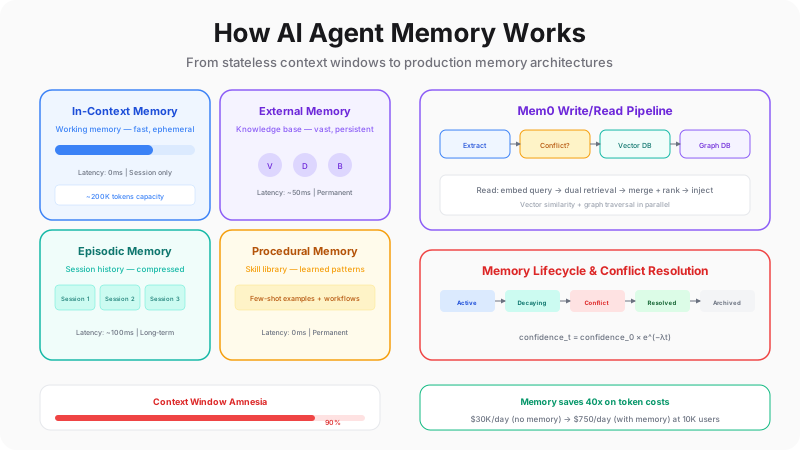
The cost dimension makes this even worse. A 200K-token context at $15/MTok costs $3 per messagejust for input tokens. Running 10K daily active users at this context size costs $30K/day. A memory system that compresses context to 5K tokens of the most relevant information reduces this to $750/day — a 40x cost reduction. Memory isn't just about quality; it's about economic viability. Let's see exactly how stateless agents break down.
Every LLM call is stateless by default — the model has no memory of previous conversations beyond what is explicitly included in the current context window. For simple Q&A this is fine, but for agents handling multi-session workflows, this creates a fundamental problem: the agent treats every conversation as if it is the first, forcing users to re-explain their context, preferences, and history repeatedly. At enterprise scale, this is not just annoying — it is a product-killing limitation. A customer service agent that forgets the customer's account type after a context window fills is functionally broken regardless of how capable the underlying model is.
🩺 Analogy: The Amnesic Doctor
A stateless agent is like a doctor who develops severe amnesia every 10 minutes. They are medically competent during each 10-minute window, but every new patient interaction requires starting completely from scratch — re-reading the chart, re-establishing rapport, re-asking basic questions. The doctor's intelligence is intact but the lack of memory makes them nearly unusable for ongoing patient care.
Context Window Amnesia Timeline
Watch how context eviction erases critical information as the conversation grows.
Turn 8 failure: Agent lost Lisa's name, team context, and preference for concise answers after context eviction. Every subsequent turn starts from zero.
Without a memory system, valuable context inevitably falls out of the window — the only question is when
The context window limit is the hard ceiling — 200K tokens for Claude, 128K for GPT-4o — but in practice, context quality degrades before the limit is hit due to the lost-in-the-middle problem. At 100K tokens, information from turn 1 is statistically less attended to than information from turn 100, even though it is technically present. The cost dimension compounds this: a 200K token context at $15/MTok costs $3 per message just for input tokens. Running 10K daily active users at this context size costs $30K/day in input tokens alone. A memory system that compresses context to 5K tokens of the most relevant information reduces this to $750/day — a 40x cost reduction.
⚠️ What Breaks
The most insidious failure mode is not the agent forgetting facts — it is the agent confidently acting on stale or contradictory information from earlier in a long conversation that has been partially evicted. An agent that forgets a constraint established in turn 3 ("never modify production data") while acting on an instruction from turn 47 ("update these records") can cause serious damage.
🧠 Senior Insight
"Token cost is a better forcing function for building memory systems than quality alone. Teams that resist building memory infrastructure because 'the context window is big enough' change their minds immediately when they see their monthly API bill. Design your memory architecture during the prototype phase — retrofitting it onto an agent system that was built assuming infinite context is significantly more work."
Memory Loss Simulator
Enter a constraint your agent must remember and see when a stateless agent forgets it.
"Never modify production database directly" lost at ~turn 25
Context window fills at turn 1000 — earlier facts evicted by turn 25
$0.97
Total cost (25 turns, no memory)
$0.6375
Total cost (25 turns, with memory)
2x cost reduction with memory system
The solution isn't a single memory type or a bigger context window — it's a hierarchy of four complementary memory systems, each handling a different timescale and information type. This mirrors how human memory actually works: you don't store today's grocery list the same way you store your childhood memories. Let's explore the four types.
The Four Memory Types
Human cognitive science gives us a powerful framework for thinking about agent memory. We don't have one “memory organ” — we have multiple interacting systems: working memory (what you're thinking about right now), episodic memory (specific events and conversations), semantic memory (facts and knowledge), and procedural memory (how to do things). Each operates on different timescales and stores different kinds of information.
Agent memory architectures mirror this structure. Conversation memory is the equivalent of working memory — the current dialogue and its immediate context. Episodic memorystores specific interactions: “Last Tuesday, the user asked about React hooks and preferred TypeScript examples.” Semantic memorycaptures extracted facts: “This user is a senior engineer who works at Stripe.” And procedural memoryencodes learned behaviors: “When this user asks for code, always include error handling.”
The magic happens when these systems work together. Episodic memory feeds semantic memory (repeated interactions crystallize into facts). Semantic memory enriches conversation memory (known preferences shape responses). Procedural memory adapts based on feedback. Understanding each type — its storage mechanism, retrieval strategy, and failure modes — is essential for building agents that feel genuinely intelligent. Let's dive in.
Production agent memory systems are architecturally analogous to human memory — a hierarchy of stores with different capacities, speeds, and persistence. In-context memory is working memory: fast and instantly accessible but small and ephemeral. External memory is long-term declarative memory: vast and persistent but requires retrieval. Episodic memory captures past experiences and sessions, while procedural memory stores learned skills and behavioral patterns. Effective agents combine all four rather than relying on any single layer.
👩💼 Analogy: The Veteran Service Manager
The four memory types map directly to how a veteran customer service manager operates. In-context memory is what they are actively thinking about during the current call. External memory is the customer database they query. Episodic memory is their recollection of this customer's previous calls. Procedural memory is their training — the escalation procedures and communication patterns they apply automatically without looking them up.
Four Memory Types — Architecture
Click any quadrant for details. Each handles a different information timescale.
Query Routing Order
Each memory type handles a different information timescale — the agent orchestrates all four in every response
The orchestration logic determines which memory types to consult for a given query — consulting all four on every request is wasteful. A lightweight query classifier routes to the appropriate stores: a factual question about the user's past triggers episodic retrieval, a domain knowledge question triggers external retrieval, a procedural question about how to format an output retrieves from the skill library. The assembled context from all relevant stores is then merged into the in-context memory for the current request. Latency budgeting matters: external and episodic retrieval add 50–150ms per request, which is acceptable for most agent applications but must be accounted for in SLA design.
⚠️ What Breaks
Treating all four memory types as optional "nice to have" rather than architectural requirements produces agents that work in demos and fail in production — the demo always fits in one context window, production workflows span weeks and involve users with complex histories. The first production incident that traces to "agent forgot a constraint from last month" converts every skeptic to a memory architecture advocate.
🧠 Senior Insight
"The most overlooked memory type in agent systems is procedural. Teams invest heavily in external knowledge retrieval and episodic summaries but neglect to build a living library of few-shot examples that encode domain-specific reasoning patterns. An agent with access to 50 high-quality worked examples of how to handle edge cases in your domain outperforms an agent with 100x more knowledge base content but no worked examples."
Memory Type Selector Quiz
For each scenario, decide which memory type(s) the agent should consult.
1. "User asks a follow-up from last week's conversation"
2. "User asks about your company's refund policy"
3. "User asks the agent to format output a specific way"
4. "Agent needs to remember a constraint set 2 minutes ago"
5. "Agent needs today's exchange rate"
With the four types understood conceptually, let's zoom into the most immediately practical one: conversation memory. This is where you'll spend most of your engineering effort, and the implementation choices here have massive impacts on quality, cost, and latency. There are several distinct strategies, each with very different tradeoffs.
Conversation Memory Strategies
How do you fit a 200-turn conversation into a 4K-token context window? This is the core engineering challenge of conversation memory, and different strategies give radically different results. The simplest approach — sliding window — just keeps the last N messages and drops everything else. Fast and cheap, but it literally amputates the agent's long-term memory.
More sophisticated strategies use summarization (compress old turns into a paragraph), entity extraction (pull out key facts and track them separately), or hybrid approaches that combine a sliding window for recent context with a summary of older turns and a vector store for semantic retrieval. Each strategy sits on a spectrum of cost vs. quality vs. latency. A production system making 100K API calls/day needs to carefully choose where on that spectrum to operate.
The interactive comparison below lets you see how each strategy handles the same conversation — what it remembers, what it forgets, how much it costs, and how much latency it adds. Play with the sliders to understand the tradeoffs at different scales.
Conversation memory is where most teams start because the problem is immediate and visible — users hate repeating themselves. Four strategies exist with progressively better quality-to-cost ratios: full history (naive), sliding window, summarization, and vector retrieval. Each solves the amnesia problem differently, and the right choice depends on conversation length, topic diversity, and whether sequential context matters more than relevance. Most production systems combine strategies — a sliding window of recent turns plus summarization of older turns plus vector retrieval of highly relevant past moments.
📰 Analogy: The Journalist's Interview Prep
Think of these four strategies as different ways a journalist might prepare for an ongoing interview series. Full history means re-reading every transcript every time (comprehensive but slow). Sliding window means only reading the last 3 transcripts (fast but forgets early context). Summarization means maintaining a running summary updated after each session (efficient, captures key points). Vector retrieval means indexing all transcripts and searching for the most relevant past exchanges before each new session (precise but requires infrastructure).
Four Strategies — Same 20-Turn Conversation
Click each strategy to see what the agent knows and what it costs.
What's in context
1,260
Tokens / request
$0.019
Cost / request
∞
Max turns before limit
Relative cost per request
The same 20-turn conversation costs 9x more with full history than with summarization — quality is comparable for most use cases
Summarization-based memory works by passing the oldest N turns through a fast, cheap model (GPT-4o-mini or Claude Haiku) with the prompt "summarize the key facts, decisions, and constraints from these conversation turns." The summary replaces the original turns in context, typically compressing 10 turns of ~800 tokens to a 150-token summary with minimal information loss for structured conversations. The compression ratio degrades for highly contextual conversations where exact phrasing matters — legal or medical contexts where precise wording is critical should use sliding window instead. Vector retrieval complements summarization by handling long-horizon references: if a user in turn 47 references a specific example from turn 5, semantic search retrieves it even if it was not captured in the summary.
⚠️ What Breaks
Summarization-based memory has a subtle failure mode for contradictory instructions — if a user says "always respond formally" in turn 2 and "be more casual" in turn 15, a careless summary may capture only the most recent instruction, silently overriding the earlier one without flagging the contradiction to the agent. Production summarization prompts should explicitly instruct the summarizer to flag and preserve contradictions rather than resolving them silently.
🧠 Senior Insight
"The summarization model choice matters more than most teams realize. Using the same large, expensive model for summarization as for generation is a common waste — the summarization task is simple enough that GPT-4o-mini or Claude Haiku performs equivalently at 10–20x lower cost. The one exception is highly technical conversations where specialized terminology must be preserved accurately — in those cases, a domain-aware larger model is worth the cost."
Strategy Comparator
Ask a question that requires remembering something from early in the conversation — see which strategy gets it right.
"What was the constraint I mentioned at the start?"
These strategies are the building blocks, but implementing them from scratch for every project is painful. Mem0, the most widely adopted open-source agent memory library, synthesizes these strategies into a unified system with a clean API. Understanding its internals reveals the production-ready architecture behind the abstraction — and helps you decide whether to use it, fork it, or build your own.
Mem0 Internals — How Production Memory Works
Mem0 (pronounced “mem-zero”) is to agent memory what Redis is to caching — the de facto standard that most production systems either use directly or draw inspiration from. With 25K+ GitHub stars, it powers memory for thousands of AI applications. But what's actually happening under the hood? How does it decide what to remember, how to store it, and when to retrieve it?
At its core, Mem0 uses a dual-store architecture: a vector database (Qdrant, Pinecone, or Chroma) for semantic similarity search, and a graph database (Neo4j) for structured relationships. When you call mem0.add(), the system doesn't just dump your text into a database — it runs an LLM extraction pipeline that identifies facts, preferences, and relationships, deduplicates against existing memories, resolves conflicts with previous entries, and stores the result with rich metadata.
When you call mem0.search(), it performs hybrid retrieval — combining vector similarity (for semantic relevance) with graph traversal (for relationship-aware context) — and returns the most relevant memories ranked by a combination of similarity score, recency, and access frequency. The system diagram below traces the full pipeline from input to storage to retrieval.
Mem0 is an open-source memory layer for AI agents that abstracts the complexity of managing multiple memory stores behind a simple add/search API. Under the hood it combines LLM-based fact extraction, a vector database for semantic retrieval, and a graph database for relationship tracking — three separate systems coordinated by a unified orchestration layer. What makes Mem0 production-ready is its handling of memory updates and conflicts: when new information contradicts stored memory, it does not blindly overwrite — it versions the old memory and flags the contradiction for resolution. This versioning prevents the silent data corruption that plagues naive memory implementations.
📋 Analogy: The Meticulous Personal Assistant
Mem0 works like a meticulous personal assistant who not only writes down everything you tell them but also cross-references new information against their notes. When you say "I now prefer Python over Go," they do not erase the old note — they write "preference updated: Python preferred over Go as of [date], previously preferred Go." This creates an auditable memory trail rather than a single overwritten fact.
Memory Write / Read Pipeline
Click any node for implementation details.
Write Path
Read Path
Mem0's dual-storage design — vector DB for similarity, graph DB for relationships — retrieves memories that keyword or vector search alone would miss
The graph database layer is Mem0's most distinctive architectural choice. While vector search retrieves semantically similar memories, graph traversal retrieves structurally related ones — all memories about a specific entity, all facts connected by a relationship type.
⚠️ What Breaks
The LLM extraction step is the quality bottleneck — if the extraction model fails to identify a constraint as worth storing (treating "never suggest deleting production data" as a conversational aside rather than a persistent rule), that constraint never enters memory and the agent behaves as if it was never said. Extraction prompt engineering deserves as much attention as the retrieval architecture.
🧠 Senior Insight
"Memory decay is an underimplemented feature in most production deployments. Memories should have a confidence score that decays over time without reinforcing access — a preference stated 8 months ago is less reliable than one stated last week. Mem0 supports confidence decay configuration, but most teams leave it at the default. Setting aggressive decay rates for preference memories (but not for factual memories) prevents stale preferences from overriding current user intent."
Memory Evolution Simulator
Step through each turn and watch how Mem0 builds, updates, and versions memories as new information arrives.
Hi, I'm Lisa from Lindsey Tech. I work on the WordPress team.
← NextNice to meet you, Lisa! How can I help with WordPress today?
I prefer concise, technical answers. No hand-holding please.
Actually, I recently switched from WordPress to the React team.
Can you help me set up a Next.js project?
Memory Store (0 memories)
No memories yet — process the first turn to begin.
Mem0's architecture is elegant, but memory systems introduce a new category of failure that most agent developers discover the hard way: what happens when memories conflict, become stale, or are simply wrong? The user said they prefer Python last month but switched to Rust this week. Two memories contradict each other. The agent confidently acts on outdated information. These failure modes are subtle, hard to debug, and can erode user trust faster than having no memory at all.
Memory Conflicts, Staleness, and Forgetting
Here's an uncomfortable truth about agent memory: a wrong memory is worse than no memory. If an agent has no memory of your dietary preferences, it might ask — slightly annoying but harmless. If it confidently remembers you're vegetarian (you were, six months ago, but you've since changed), it silently filters out every restaurant recommendation with meat. The user doesn't know why the suggestions feel off. They just think the agent is bad.
Memory conflicts are the distributed systems problem of AI agents. Two memories stored at different times may directly contradict each other. A preference might be conditional (“I like Python for scripts but Rust for systems work”) but stored as absolute. Temporal decay means some facts expire (your current project) while others are permanent (your name). Getting this wrong doesn't crash the system — it produces subtly wrong behavior that's extremely hard to debug.
The strategies for handling these failures — conflict resolution policies, confidence scoring, temporal decay functions, and explicit forgetting mechanisms — are what separate a toy demo from a production memory system. Let's explore the failure modes and their solutions.
Memories go stale. A user's preferred programming language, job title, or technology stack may change, and an agent that confidently personalizes responses based on an 18-month-old memory of "prefers Java" to a developer who has since moved to Rust creates the worst kind of experience — confidently wrong. Memory systems need explicit staleness handling: confidence decay over time, recency weighting in retrieval, and periodic re-confirmation for high-stakes persistent preferences. Forgetting, counterintuitively, is a feature rather than a failure — the right memory system knows what to discard.
📉 Analogy: The Stale CRM Profile
Memory staleness is like a customer profile in a CRM that was last updated three years ago. The sales rep who treats that profile as ground truth — calling the prospect's old company, referencing their former role — does more damage than a rep who admits they do not know the current details and asks. Confident application of stale memory is worse than no memory at all.
Memory Lifecycle — State Diagram
Click each state to see the memory card at that point in its lifecycle.
10 days without reinforcement
Contradicting memory arrives
Resolution: newer wins
90 days no access
User says "forget this"
High Confidence
"User prefers Python"
confidence
Age: 2 days
Confidence decay prevents stale memories from overriding fresh context — the curve is steeper for preferences than for facts
Confidence decay should be implemented as an exponential decay function: confidencet = confidence0 × e−λt where λ is the decay constant tuned per memory category. Facts (user's name, company) should decay very slowly (λ ≈ 0.001/day) while preferences (communication style, favorite tools) should decay faster (λ ≈ 0.01/day). The decay is halted and confidence reset to its original value on each reinforcing access — if a memory is retrieved and the user's behavior confirms it, confidence is maintained. Conflict resolution strategy should be configurable per memory category: for preferences, newer wins; for facts, higher-confidence wins; for constraints, both are preserved and flagged for human review.
⚠️ What Breaks
Systems that never forget accumulate contradictory memories over time and the retrieval model begins returning inconsistent results — the agent finds itself with memories saying the user both "prefers formal communication" and "prefers casual communication" with equal confidence scores, producing incoherent personalization. Regular memory auditing (a weekly background job that identifies and resolves low-confidence contradictions) is the production solution.
🧠 Senior Insight
"Build a memory audit UI for your team from day one. The ability to inspect, edit, and delete a specific user's memories is not just a privacy requirement (GDPR right to erasure applies to AI memory stores) — it is essential for debugging agent behavior. When an agent acts unexpectedly, the first diagnostic question is always 'what does it remember about this user?' and without an audit interface, that question takes an engineer hours to answer via database queries."
Conflict Resolution Demo
Pick a resolution strategy and see how it affects the agent's next response — then adjust the decay rate to see how staleness changes the decision.
Memory 1 (3 months old)
"User is a backend Java engineer"
Original confidence: 0.92
After decay: 0.37
Memory 2 (1 week old)
"User moved to ML engineering"
Confidence: 0.72 (single mention)
Resolution Result
Memory updated to: "ML engineer" (previously "backend Java engineer"). Old memory archived with timestamp.
What the agent says next
Based on your recent transition to ML engineering, I'd recommend starting with PyTorch for your deep learning projects...
Confidence decay curve (λ = 0.01)
Bringing It All Together
Agent memory is not a feature you bolt on at the end — it's a fundamental architectural decision that shapes your entire system. The four memory types give you the conceptual framework. Conversation strategies give you the implementation toolkit. Mem0 gives you a production-ready starting point. And understanding conflict resolution keeps your system trustworthy as memories accumulate over time.
The teams that get memory right build agents that feel genuinely intelligent — agents that remember your preferences, learn from past interactions, and improve with every conversation. The teams that skip it build agents that feel like talking to a stranger every single time, no matter how powerful the underlying model. Memory is the difference between a demo and a product. Design it early, test it thoroughly, and always assume your memories might be wrong.